Regulatory update · Compliance & regulation
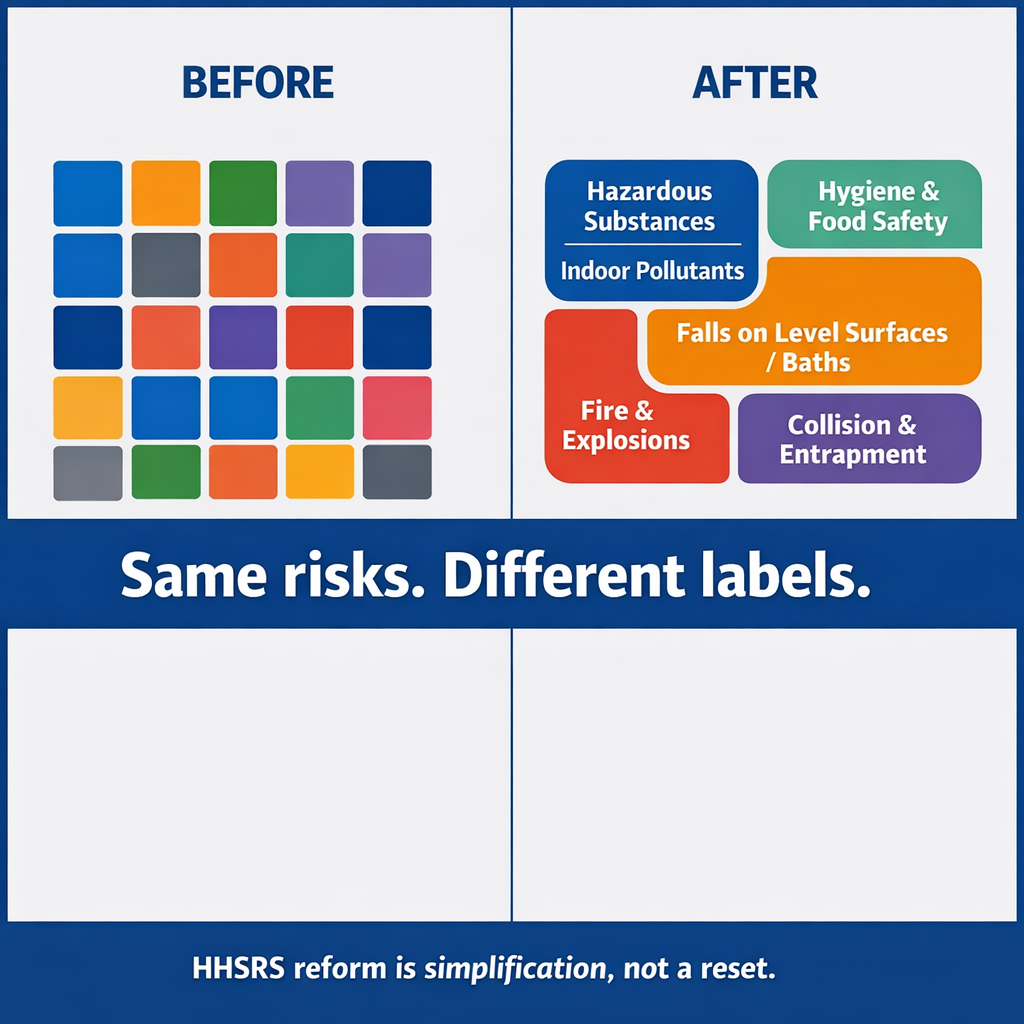
The Housing Health and Safety Rating System is being revised. The current 29-hazard model is being restructured into 21 hazards — largely through amalgamating closely related categories into broader groupings. Government confirmed this direction in its 2023 HHSRS review outcomes. The revised system is not yet in force and no commencement date has been confirmed, but the direction of travel is clear enough to plan for.
What this isn’t This isn’t a wholesale rewrite of HHSRS. Most hazards survive intact. The change is structural — a tidying of overlapping categories — rather than a shift in the underlying risk assessment methodology.
The five amalgamations
Eight legacy hazards are absorbed into four revised groupings, and three hygiene-related hazards merge into one. Everything else is retained as its own heading.
Hazardous substances / combustion products / indoor pollutants
- Biocides
- Carbon monoxide and fuel combustion products
- Uncombusted fuel gas
- Volatile organic compounds
Hygiene / sanitation / food safety
- Domestic hygiene, pests and refuse
- Food safety
- Personal hygiene, sanitation and drainage
Falls on level surfaces / baths
- Falling on level surfaces
- Falls associated with baths
Fire and explosions
- Fire
- Explosions
Collision / entrapment / operability of amenities
- Collision and entrapment
- Position and operability of amenities
Full hazard mapping — 29 to 21
Hazards marked Combined are absorbed into a broader grouping. Those marked Unchanged retain their own heading in the revised model.
| Legacy hazard | Revised grouping | Status |
|---|---|---|
| A — Physiological requirements | ||
| Damp and mould growth | Damp and mould | Unchanged |
| Excess cold | Excess cold | Unchanged |
| Excess heat | Excess heat | Unchanged |
| Asbestos and MMF | Asbestos and fibres | Unchanged |
| Biocides | Hazardous substances / combustion products / indoor pollutants | Combined |
| Carbon monoxide and fuel combustion products | Hazardous substances / combustion products / indoor pollutants | Combined |
| Lead | Lead | Unchanged |
| Radiation | Radiation | Unchanged |
| Uncombusted fuel gas | Hazardous substances / combustion products / indoor pollutants | Combined |
| Volatile organic compounds | Hazardous substances / combustion products / indoor pollutants | Combined |
| B — Psychological requirements | ||
| Crowding and space | Crowding and space | Unchanged |
| Entry by intruders | Entry by intruders | Unchanged |
| Lighting | Lighting | Unchanged |
| Noise | Noise | Unchanged |
| C — Protection against infection | ||
| Domestic hygiene, pests and refuse | Hygiene / sanitation / food safety | Combined |
| Food safety | Hygiene / sanitation / food safety | Combined |
| Personal hygiene, sanitation and drainage | Hygiene / sanitation / food safety | Combined |
| Water supply | Water supply | Unchanged |
| D — Protection against accidents | ||
| Falls associated with baths | Falls on level surfaces / baths | Combined |
| Falling on level surfaces | Falls on level surfaces / baths | Combined |
| Falling on stairs | Falling on stairs | Unchanged |
| Falling between levels | Falling between levels | Unchanged |
| Electrical hazards | Electrical hazards | Unchanged |
| Fire | Fire and explosions | Combined |
| Explosions | Fire and explosions | Combined |
| Position and operability of amenities | Collision / entrapment / operability of amenities | Combined |
| Collision and entrapment | Collision / entrapment / operability of amenities | Combined |
| Structural collapse and falling elements | Structural collapse and falling elements | Unchanged |
Baseline indicators — what’s confirmed and what’s probable
The revised model introduces “baseline indicators” — plain-language thresholds intended to help landlords and tenants make an initial assessment before a full HHSRS risk assessment is needed.
Government confirmed Where baselines are met, a property is likely to be free from Category 1 hazards. Baselines do not replace the full risk assessment — they are an initial filter, not a substitute.
The only publicly confirmed example baseline to date is for falls on stairs:
“Stairs must be safe, secure, in sound condition, free of defects and projections, well maintained.” MHCLG — confirmed baseline indicator, falls on stairsStill outstanding Full baseline wording for most hazards has not yet been published. Once full baselines are released by MHCLG, this post will be updated.
What this means operationally
The amalgamations are largely administrative. The risks haven’t changed — the headings have. A few practical points worth keeping in mind:
- Lead and radiation remain standalone hazards — they are not swept into the combined pollutants group, despite sitting near it in the structure.
- The hygiene merger (domestic hygiene, food safety, personal hygiene/sanitation) is operationally sensible — these defects routinely arrive together in the same case.
- Organisations running inspection or stock condition survey frameworks against the 29-hazard model will need to remap, but this is largely a labelling exercise rather than a change to what gets inspected.
- The baseline indicators, once fully published, are likely to be useful for pre-inspection triage — watch for the full release from MHCLG.
Source: MHCLG HHSRS review outcomes (2023). No commencement date for the revised system has been confirmed. Last reviewed April 2026. · socialhousing.ai