The organisations winning on compliance aren’t doing more.
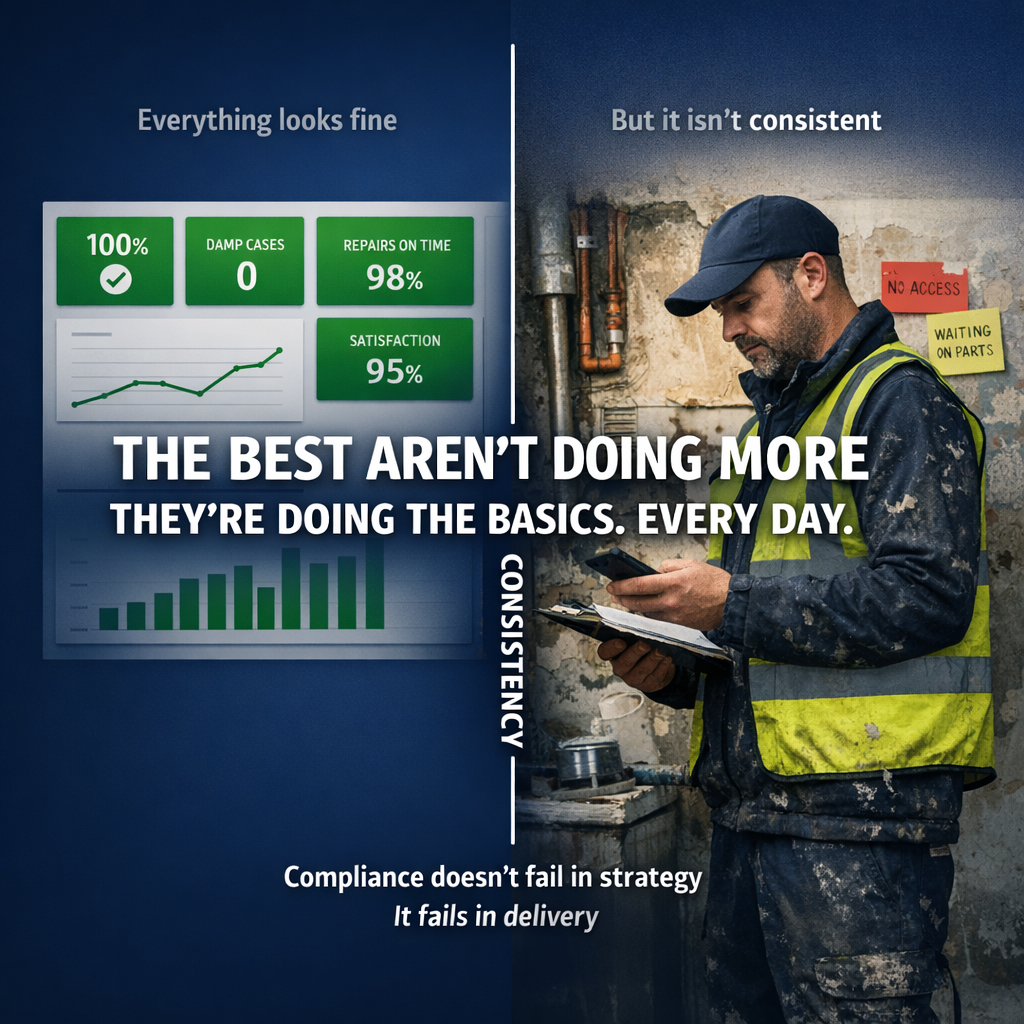
They’re doing the basics, consistently.
There’s a quiet misconception in the sector at the moment.
When we see organisations performing well on compliance, passing inspections, staying ahead of issues like damp and mould, meeting their obligations under Awaab's Law and the Consumer Standards, the assumption is often:
They must be doing more.
More investment.
More systems.
More people.
More process.
In most cases, they’re not.
They’re just doing the basics better, and more importantly, they’re doing them every day.
Compliance isn’t a volume problem. It’s a consistency problem.
Across dozens of services, the same pattern shows up.
Policies are in place.
Systems are in place.
Processes exist.
On paper, everything looks compliant.
But compliance doesn’t fail on paper.
It fails in delivery.
- Follow-on works that don’t get raised properly
- Jobs that sit waiting for materials with no visibility
- “No access” recorded, but no meaningful re-engagement
- Supervisors tied to screens instead of being on site
- Data recorded, but not checked, challenged, or acted on
None of this is about capability.
It’s about consistency.
The gap isn’t knowledge. It’s control.
Most teams know what good looks like.
They know:
- A damp and mould case should be diagnosed properly first time
- A repair should not close until the outcome is achieved, not just the task
- Vulnerable residents should not fall through the gaps
- Compliance actions should be tracked to completion, not assumption
But knowing and doing are two very different things.
The organisations that are getting this right have closed that gap.
Not with more strategy.
With tighter control.
What the better-performing organisations are actually doing
When you look closely, the difference is surprisingly simple.
1. They make the basics visible
They don’t rely on dashboards that tell a comforting story.
They track the things that expose reality:
- Outstanding follow-ons
- Jobs waiting on materials
- Repeat visits on the same issue
- Aged compliance actions
- Cases with multiple contacts from the same resident
Nothing hidden. Nothing softened.
2. They check performance daily, not monthly
Most services review performance retrospectively.
The better ones don’t wait.
By mid-afternoon, they know:
- What hasn’t been completed
- Where operatives are off track
- Which jobs need intervention
That allows them to recover the day, not explain it a month later.
3. They put supervision back where it belongs
In too many services, supervisors have become system managers.
The high-performing teams are different.
Supervisors:
- Visit jobs
- Check quality on site
- Speak to residents directly
- Challenge poor performance early
Not occasionally. Routinely.
That single shift changes everything.
4. They treat compliance as an outcome, not a process
Most organisations can show you their process.
Fewer can show you consistent outcomes.
The difference is mindset.
They don’t ask:
“Did we follow the process?”
They ask:
“Did the resident get the right outcome, first time?”
That’s what regulators are now looking for.
Why others are struggling
It’s not because they don’t care.
And it’s not because they lack investment.
It’s because complexity has crept in.
New systems layered onto old problems.
More reporting, less understanding.
More process, less ownership.
And slowly, the basics drift.
Not overnight.
Over time.
Until:
- Backlogs are unclear
- Data can’t be trusted
- Compliance becomes reactive
- And risk sits beneath a green dashboard
The truth
You don’t need a new system to improve compliance.
You don’t need a restructure.
You don’t need another strategy document.
You need to get ruthless about the basics.
Every day.
Without exception.
Because the organisations that are performing well right now haven’t found a shortcut.
They’ve just removed the gaps.
What this means in practice
If you’re leading a service right now, the question isn’t:
“Do we have the right processes?”
It’s:
- Are we applying them consistently?
- Can we evidence outcomes, not activity?
- Do we know where today is going wrong before it ends?
- Are our supervisors controlling the service, or observing it?
Because that’s where compliance lives or fails.
Not in policy.
Not in systems.
In what happens on the ground, every single day.