You’re not starting from zero on Awaab’s Phase 2 - so why are so many landlords acting like they are?
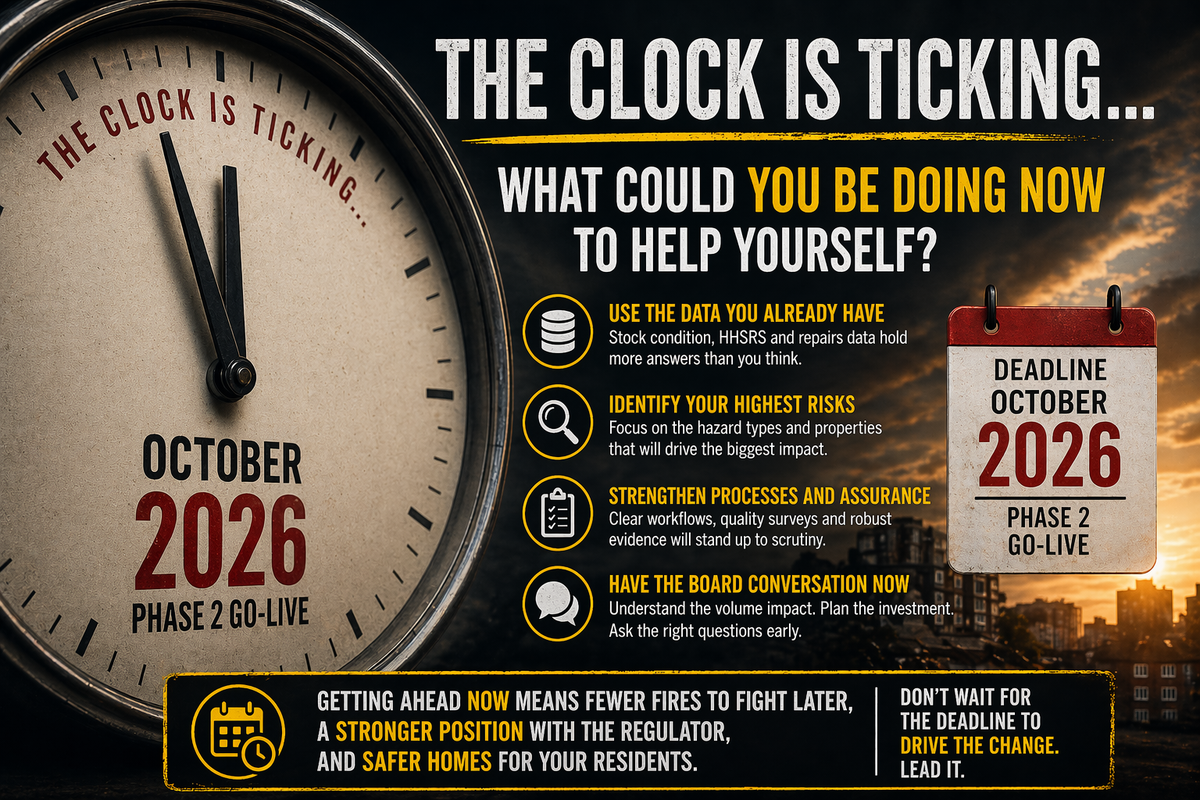
Every week I see another LinkedIn post, another sector briefing, another webinar invitation treating Awaab’s Law Phase 2 as though it’s arriving from nowhere in October 2026. A new problem. An unknown quantity. Something to brace for.
I want to push back on that - respectfully but firmly.
For most landlords, a significant proportion of the hazard picture that Phase 2 brings into scope is already documented somewhere in your organisation. It’s sitting in your stock condition survey data. It’s in your HHSRS assessment records. It’s buried in years of responsive repairs history.
The question isn’t whether you have data. It’s whether you have a joined-up view of it - and the leadership appetite to act on it, before October 2026 forces your hand.
First, let’s be clear about what Phase 2 actually means operationally
Phase 1, which came into force in October 2025, was hard — but it was essentially a repairs triage and documentation challenge. Damp and mould, emergency hazards, statutory clocks, written findings. Difficult, but containable within existing structures for most organisations.
That said, Phase 1 also exposed something the sector is still working through — a competency gap in how some of those hazards were assessed. Many organisations relied on general inspectors rather than specialist surveyors with strong building pathology knowledge. The result was often inconsistent diagnosis, repeat visits, and data that tells you something happened, but not always what the underlying issue was.
Phase 2 is a different scale of problem entirely. From October 2026, the same mandatory investigation and make-safe timeframes will apply to a significantly wider hazard set: excess cold and heat, falls, structural risks, fire and electrical hazards, explosion risks, and domestic hygiene and food safety. These aren’t edge cases, they sit at the heart of what social housing maintenance deals with every day.
The practical impact? For many landlords, the proportion of repairs subject to a statutory clock could increase significantly. A boiler failure in an occupied property has the potential to become a compliance-driven event with a 24-hour legal clock attached, depending on vulnerability and risk. A communal heating failure affecting multiple tenants simultaneously is no longer something to schedule when an engineer is available, it’s a high-urgency compliance event.
And this shift towards evidence-led, risk-based intervention is exactly the direction of travel being reinforced by the Regulator of Social Housing.
That’s the stakes. Now here’s the part most people aren’t saying.
The data already exists - for a large part of the picture
The HHSRS framework has existed since 2005. Any landlord who has conducted stock condition surveys in the last several years has data that maps almost directly onto the hazard categories Phase 2 is bringing into scope. Excess cold ratings. Fall hazard assessments. Electrical condition findings. Structural observations. These aren’t new concepts invented by Awaab’s Law, they’re categories your surveyors have already been scoring against.
Add to that your responsive repairs history. Repeat heating callouts. Recurring electrical jobs. Documented trip hazards and structural defects. That’s a de facto risk register if you know how to read it, and if your systems allow you to interrogate it properly.
Most organisations aren’t data-poor here. They’re insight-poor.
Put those two datasets together and most landlords already hold a usable, if imperfect, view of their Phase 2 exposure today, without commissioning a single new survey or buying a single new piece of software.
I want to be honest about the limitations here, because this isn’t a complete solution and I’m not going to pretend otherwise. Stock condition data ages. Many organisations are working off surveys that are five or more years old, with patchy coverage across their portfolio. Repairs data is often messy, inconsistently categorised, and siloed away from property and tenancy information. And the ‘significant risk of harm’ threshold that triggers Awaab’s Law obligations requires professional judgement that data alone can’t fully replace.
It’s also worth being honest about capability and capacity. Phase 1 didn’t just test processes, it stretched the sector’s access to suitably qualified surveyors. Demand increased sharply, and many organisations were competing for a limited pool of experienced professionals. That pressure hasn’t gone away. If anything, Phase 2 is likely to intensify it.
But, and this matters, imperfect data intelligently applied is considerably more useful than waiting for perfect data that will never arrive.
So why aren’t more organisations doing this?
In my experience, it usually comes down to one of three things.
The first is data silos. Surveying data lives in one system, repairs in another, tenancy and vulnerability information somewhere else entirely. Nobody has joined it up, and doing so feels like a project in itself. That’s true, but it’s a project worth doing now rather than in October 2026 under regulatory pressure.
The second is organisational inertia. The data being available doesn’t mean there’s appetite to act on it pre-legislatively. Boards and finance committees respond to deadlines, not to early warnings, and ‘we could get ahead of October 2026’ is a harder sell than ‘we’ll be in breach if we don’t.’
The third, and I’ll be blunt about this, is a gap in leadership focus. Using existing data to proactively plan ahead requires someone at Director or Exec level to ask the right question: not ‘what do we need to comply?’ but ‘what does our data already tell us, and what can we do with it?’ That question isn’t being asked nearly enough in my experience.
The organisations that get this right will arrive at October 2026 in a fundamentally different position
Think about what proactive looks like in practice. An organisation that interrogates its existing stock condition and repairs data now, identifies its highest-risk properties and hazard types, and builds a planned programme of remediation over the next six months arrives at go-live with:
• A materially lower live caseload on day one of Phase 2
• Contractors who have been briefed, prepared, and have capacity planned in advance
• An audit trail that demonstrates proactive safety culture, which is exactly what the Regulator of Social Housing is looking for
• A board that can evidence it asked the right questions early, not just when compliance deadlines forced the issue
The organisations that wait will be managing compliance and volume simultaneously from day one, under regulatory scrutiny, with contractors who are just as overwhelmed as they are.
That’s not a minor operational difference. It’s the difference between managing Phase 2 and being managed by it.
Three questions worth asking in your organisation right now
When did your stock condition data last feed into a Phase 2 hazard risk assessment? If the answer is ‘it hasn’t’ or ‘I’m not sure,’ that’s your starting point.
Can your repairs data be interrogated by HHSRS hazard category? If your job codes are bespoke local labels rather than mapped to HHSRS, you have a taxonomy problem that will hurt you at go-live.
Does your board understand the volume impact of Phase 2, not just the legal obligations? Compliance briefings tend to focus on timescales and penalties. The operational capacity question - what happens when your statutory caseload increases significantly? is less often on the agenda.
And one more: how much of the data you already hold do you actually trust, and what are you doing about the gaps before October 2026?
If any of this resonates and you’d like to talk it through, drop me a message on LinkedIn. Always happy to have a straight conversation.
#SocialHousing #AwaabsLaw #AssetManagement #HousingCompliance #SocialHousingAI